Signs your Yakima Valley home needs rewiring
Older homes hide their wiring problems well, so the clues are usually small and easy to dismiss.
October 7, 2026 · 4 min read
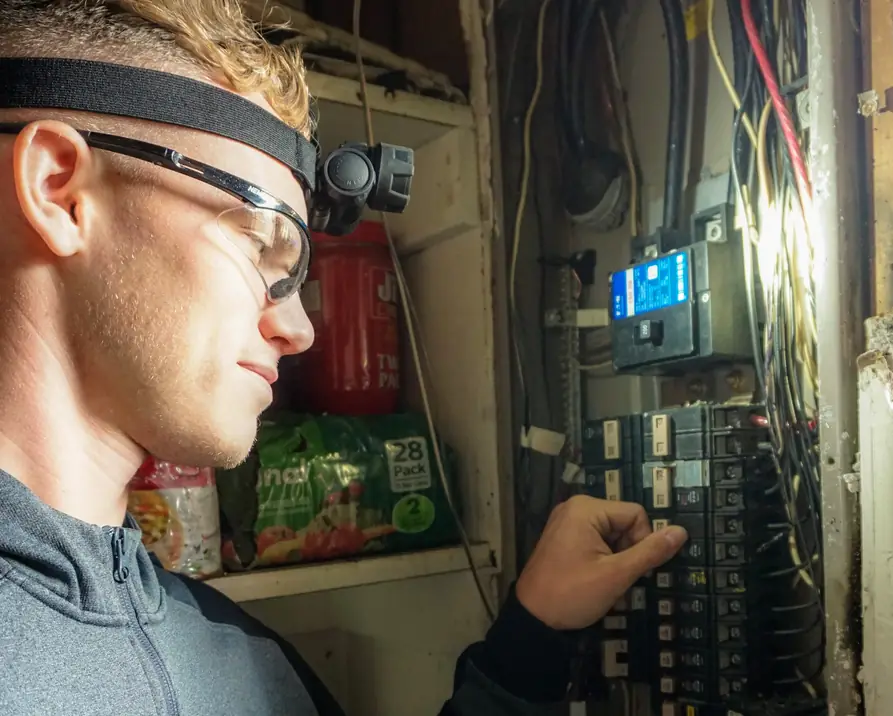
Houses in the Yakima Valley span a lot of decades. Some were built when a home had a handful of outlets and a single kitchen appliance, and many have been added onto, remodeled, and added onto again. The wiring inside those walls has worked quietly for years, which is exactly why people stop thinking about it. The warning signs are rarely dramatic. They are small habits of the house that you learn to live with, and a few of them deserve a closer look.
Signs you can see and feel
Start with the lights. Brief flickering when a large appliance kicks on, or lights that dim every time the dryer starts, can mean a circuit is carrying more than it was meant to. Occasional flicker from a loose bulb is nothing to worry about. A pattern is different. If it happens in the same rooms, at the same times, it is worth writing down.
Next, put your hand on outlets and switch plates. They should feel the same temperature as the wall. One that feels warm, or a plate with a brownish tint, tells you heat is building up somewhere behind it, usually at a loose or worn connection. Other clues are a faint burning smell near an outlet, a buzzing or crackling sound, and plugs that fall out of the receptacle because the contacts have lost their grip. Stop using any outlet that does any of these things and have someone look at it.
Then count the two-prong outlets. If you have them, the circuit probably has no ground wire, which matters because the ground gives stray current a safe path. Swapping in a three-prong receptacle without a real ground behind it looks tidy but protects nothing, so ask an electrician what your wiring can support before you buy a box of new outlets.
Breakers that keep tripping
A breaker is built to trip. That is its job, and a breaker that trips once during a holiday dinner with every burner and the oven running is doing what it should. The pattern to take seriously is a breaker that trips often, one that feels hot, or one that won’t stay reset. Frequent tripping means the circuit is overloaded, or there is a fault somewhere on it. Resetting it over and over is not a fix, and replacing it with a larger breaker is a real hazard, because the wire behind it may not handle the extra current.
Extension cords and power strips running through the house are a quiet sign of the same problem. When a home keeps asking for more outlets than the wiring provides, the cords make up the difference, and they were never meant to be permanent wiring.
Old materials worth knowing about
Some homes built before the middle of the last century may still have cloth-covered wires, and a few have the older knob-and-tube system. The insulation on those conductors gets brittle with age, and it can crumble when disturbed. Some houses from the 1960s and 1970s have aluminum branch wiring instead of copper, which expands and contracts differently and can loosen at its connections over time. You usually can’t identify either from the outside, but an electrician can spot them in the attic, the panel, or at an open outlet box.
Remodels add their own layer. Many houses have wiring from three different eras, joined together by whoever did the last project. A kitchen update that tied new circuits into old ones is a common source of mystery in a panel.
Rewiring versus a wiring upgrade
The word rewiring sounds like tearing the house apart, and sometimes it is a big job. But the right answer depends on what the electrician finds. A whole-home rewiring replaces the old circuits throughout the house, and it makes the most sense when the wiring itself is the problem. A wiring upgrade is narrower. It might mean new circuits for a kitchen or a workshop, replacing a few runs that have failed, adding grounding where it is missing, or bringing the panel up to date so it can feed the rest.
A customer once told us a second opinion on a job turned up a different solution that cost thousands of dollars less than the first bid. We bring it up not to brag but because it is a fair reminder: ask what the problem actually is, ask for it in plain language, and ask whether there is a smaller fix. Your inspector and your insurer will have their own requirements, and the electrician should be ready to explain which of the work is needed and which is optional.
If any of these signs sound familiar, call us at 509-388-4745 or use the contact page. We will walk through the house with you, tell you what the wiring is actually doing, and put the options in writing.
Bigfoot Electric, 509-388-4745
Call 509-388-4745More articles
My insurer flagged my electrical panel. Now what?
A flag from your insurer feels like an emergency, but it is mostly a prompt to make a plan.
Electrical safety after wind, fire or water damage
The hardest part of a damaged building is knowing what not to touch, and electricity is at the top of that list.